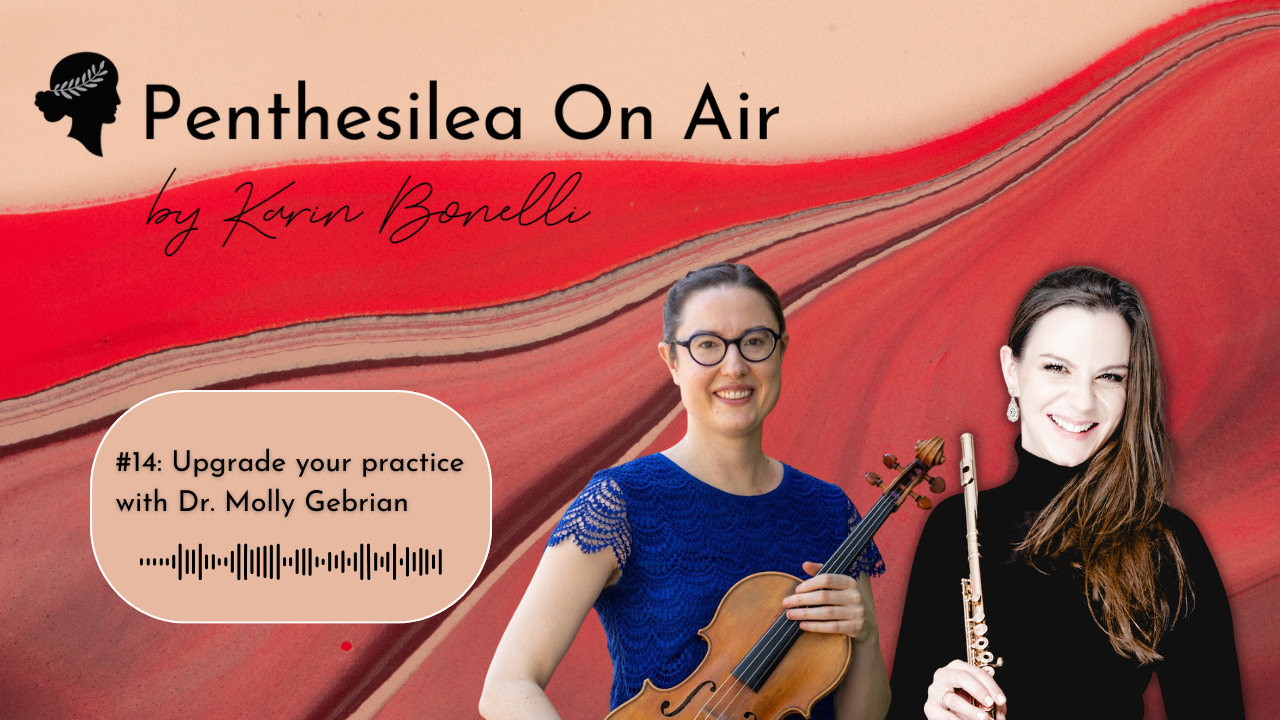

How the neuroscience of practice changed my life as a musician
This week, I had the pleasure of welcoming someone whose work has deeply touched and transformed me personally: Dr. Molly Gebrian – violist, neuroscientist, and one of the most exciting voices when it comes to making the science of learning understandable and practical for musicians.
Molly uniquely combines two worlds we often think of as separate: art and brain research. She studied both music and neuroscience, teaches the science of practicing at the New England Conservatory, and has written the book “Learn Faster, Perform Better,” which has already become a cherished insider recommendation among musicians and educators.
About serendipity
When Molly’s book found me, I had just become a mother. Sleep was a luxury, practice time a rare treasure – and yet I had to squeeze a contemporary piece into tiny pockets of time.
During this phase, one of our Academy coaches told me about Molly’s research – and suddenly, everything changed.I became more efficient.
Practicing felt lighter.
And most importantly: it became fun again.What convinced me so deeply?
That every tip is backed by a scientific experiment. No myths, no “guru vibe” – just real insights on how our brain actually works.Here are some of the key takeaways from our interview, summarized for you:
What our brain really needs when we practice
Breaks make us better. Truly.
Micro-breaks — tiny breaths for big progress
Just 10–15 seconds are enough.
When we pause briefly, the brain replays what we just practiced in fast-forward – twenty times faster! When we return, we’re already at a higher level.
Macro-breaks — the muscle soreness of the brain
Just like strength training, progress doesn’t happen while doing, but while resting.
After breaks, we come back stronger, and that’s no coincidence.
Forgetting is not the enemy
The better we know something, the longer the breaks can be.
This small forgetting – and the rediscovery – anchors knowledge more deeply.
Less is more: structure over duration
Five hours a day are enough
More doesn’t lead to better results – only exhaustion, inefficiency, and sometimes injury.25–30 minutes of focus, then a break
And after 90 minutes, a longer rest.
Memorization 101
I also spoke with Molly about my own blackout during an entrance exam – that moment when suddenly nothing is there.
Her approach is clear and comforting:
Blackouts often happen because we rely on only one type of memory.The three types of memory we need to strengthen:
• Muscle memory – how it feels
• Aural memory – how it sounds
• Cognitive memory – what’s actually on the pageThe more balanced, the more secure.
When nerves take over – and how we reclaim control
Under pressure, something paradoxical happens:
we tense up around technique – and make more mistakes.Molly’s solution:
Focus on the musical story
phrasing, sound, expression, messageMental scripts
like athletes — a plan for the mind - where do I WANT my focus to go?Bullet points for each excerpt
3–5 short cues that drop you instantly into the right character
Why this conversation lingers
This was only a small part of what we talked about – and yet I feel how much power lies within it.
Time, calm, clarity, confidence – we can reclaim all of it when we understand how our brain learns.If you…
✨ want to practice more efficiently
✨ want to change the way you think about music
✨ want to feel joy instead of pressure…then I hope listening to the full episode will inspire you beyond measure.
Visit Molly Gebrian’s website, get her book – and stay with us, because there’s bonus content with questions from our community.
I’m already looking forward to next time –
and to continuing this journey together.With love from Vienna,
Karin
🎧 Listen to the full episode here: